Friday, February 29, 2008

Colgate's facebook stats


Top Books
1. Harry Potter
2. Catcher In The Rye
3. The Great Gatsby
4. 1984
5. Pride And Prejudice
6. Angels And Demons
7. To Kill A Mockingbird
8. The Da Vinci Code
9. Lord Of The Rings

Top Movies
1. Wedding Crashers
2. Fight Club
3. Boondock Saints
4. Old School
5. Love Actually
6. Pulp Fiction
7. Garden State
8. Anchorman
9. Office Space
10. Gladiator

Top Music
1. Jack Johnson
2. Coldplay
3. The Beatles
4. Red Hot Chili Peppers
5. Counting Crows
6. Radiohead
7. Sublime
8. Led Zeppelin
9. U2
10. Billy Joel


Sunday, February 24, 2008

Thank you 1950s!

Your new favorite bands, and mine

So within the last week I caught two great concerts - Flogging Molly and Super Furry Animals. However, the best thing about these shows was discovering some excellent bands were opening, as I never would have discovered them otherwise. So I decided to share the wealth...


Rev. Peyton's Big Damn Band is a stomping three-piece band (the Rev on guitar, his wife Breezy on washboard, and his brother on drums and pickle bucket) that played the rawest, strongest blues I've ever heard live.
Jeffrey Lewis is a quirky, witty singer-songwriter-comic artist. Anyone who can open a set with a weird little song about ramen noodles is fine by me.
The Mighty Stef is Stefan Murphy out of Dublin and his band, who play vaguely nautical rock with a lot of stomp and heart.

Noble Humanitarian Efforts

Because I know some of us are inclined toward the "socially responsible living" component of our of housing "ethos," I thought, if you haven't already jumped on the bandwagon, I introduce you to a new way to participate in the movement against Mr. Bush's War. This movement encourages you to express your "Empathy through excrement. Brotherhood through bowel movement. Utopia through undulating butt pythons." Poop for Peace. It's just so damn practical. Because afterall, "Poop For Peace Day is not about protest or partisanship or politics. Poop For Peace Day is about acknowledging the fundamental basis of shared humanity: black or white, liberal or conservative, Christian or Muslim or Jew, we are all united in struggle against the tyranny of the bowel."

"So go to the bathroom and drop a grumper for your fellow man. And then come back here and proclaim it to the world."

Enjoy!

http://www.poopreport.com/index.html

Thursday, February 21, 2008

Banff Mountain Film Festival


Banff Banff Banff. Roses & thorns style.

Roses:

  • Chris Sharma. Miguel, his amigo. Ande, his rose-colored-glasses-wearing older brother figure. The guy in Venezuela who was bored and had only: a mirror with which to watch his beard grow and several sudoku.

  • "Ba! Tsaa! Arrrghhh! Weeeeee!"
  • The animated film with a grumpy badger. (Click to see a clip!)
  • Oldschool cross country ski footage

  • Kite-snowboarding is ok I guess

  • "Balance," a ski movie that is apparently non-Googlable, but go ahead and try!

  • Listing of sponsors in British accent
  • This:


Thorns:


  • Personal anecdotes.

  • Self-absorbed subjects: Ryan Leech, mountain biker, expounding on the evils of logging and how that's like when he falls off the bike; Speedfliers

  • Unicycling... more YouTube than big screen

  • Not winning door prizes once again.

Good news for us dirty hippie types

Apparently, it is now acceptable and encouraged in mainstream fashion circles to make a lifestyle change of sorts: not washing one's hair, or, at the very least, washing it infrequently.
The "trend" has extended all the way to the southern hemisphere: Sydney radio host Richard Glover is encouraging his listeners to give up any sorta cleansing when it comes to their heads. 86% of people who have participated in the experiment claim that their hair looks the same, if not better, than when they regularly wash it. Says Glover: "We're tired of feeling like cogs in the machinery of consumption. There's this feeling of liberation to be able to say no to an entire aisle of the supermarket."
Fight the power! Did you know that "rinse and repeat" is a lie?! Check it out. It was necessary in the 50s, when people greased up their hair - have you seen the Fonz? These days, it's more of a ploy because 1) shampooing twice means using it up twice as fast and buying more sooner and 2) shampooing twice means your hair will be dry, necessitating more products!

Oh. Don't assume from the tone of this post that everyone in the Loj is totally filthy all the time with hair looking like oiled kelp - far from it. However, a lot of us have done enough "backpacking weeks," "finals = no shower no sleep weeks," and/or "can't find shampoo weeks" (being only human after all) that skipping a more than a day of hairwashing isn't so scary.

Successful/hott women who did not wash their hair every day: Cleopatra, Marie Antoinette, Queen Elizabeth I, Marilyn Monroe, Delilah, Calamity Jane, Amelia Earhart, Helen of Troy.

Wednesday, February 20, 2008

The Cool List


Coolest thing so far this week: starting to build a Sonex education/student project with Bravo Zulu's Build to Fly program. It is kind of like a cross-section of a wing, but AE will be turning it into some sort of clock and barakobometer holder. It would look nice on a mantle. I'm looking forward to more fly-cutting of lightning holes next week.

Close second: Teleskiing (tele-falling-down) at Toggenburg.

Panda Politics


I would think that if a panda had a ballot, it would vote for Barack Obama.

Tuesday, February 19, 2008

Word of the Day

Barakobameter (noun)
Like a barometer, but different. Related to the Democratic presidential candidate. Not sure exactly what it measures.

As AE said, all political jokes are hilary-arious.

The Loj's Hidden Treasures: Part II/X

Whilst my housemates watch Harry Potter and the Order of the Pheonix (?), I blog about strange objects that have found their way into our house. Such is life.

Part II: The Translucent Plastic 1:12 Scale Rocking Chair


Description: Rocking chair, translucent plastic, approximately 1:12 scale. Approximately .4 lbs, 10" tall, 7x7" wide, Apparently #314 Made in USA on the "Regaline (R)" brand. Whatever that is.

Found: On coffee table in TV room enclosed porch. Contents: none, except my complete and utter confusion.

Analysis: Another one to confound the readership. My housemates told me to blog about it, and so I did. It looks like maybe it is intended to hold large square candles, or perhaps a small plant? I think it has a few potential alternate uses, though, such as a bizarre salsa dish, or rubberband holder. Not sure. When I close my eyes, I don't see this thing in action, I just see it sitting either at a garage sale or on a shelf in a Wal-Mart somewhere along with 300 identical copies that have likewise never been purchased. The faux-wood texture is a nice touch. I somehow feel like this must be associated with Allison, but I have no evidence to substantiate that other than her sly grin, yard sale saaviness, and completion of trip to Hackett's (nee Wisebuys) today.

This reminds me of two people in the house. Okay, four.

Humorous Pictures
moar humorous pics

Monday, February 18, 2008

Most 'n' Least Loj: Part I of ?

Q: What food is the least Loj?

A: Pancakes & Sausage on a Stick! (What is this? Why is there chocolate in it??)


Q: What food is the most Loj?

A: Root Vegetables!!!


Suggestions for the next Most 'n' Least are welcome...

Daily Modicum of Cuteness!


This cat belongs to CB's family, where ST and I went for dinner last night. They live in the erstwhile house of Molly and Josh, the former directors of Colgate Outdoor Ed, who built it with their own hands while expecting a child.

Anyway, back to the cat. His name is Sammy. C's mom was wondering why he was so uppity and assumed that the counter was his territory. ST postulated that it might be because he lives in a basket that sits up there. Is anything cuter than a cat in a basket? No? I agree.

Saturday, February 16, 2008

Sixth Annual Green Summit


Yesterday we held the Sixth Annual (ish - but maybe the seventh actual) Green Summit! Coordinated fabulously by MM with NS, LJ, DH, RS, and me, with AE, KG, and LW attending, too!, it brought about 80 students, faculty, staff, and community members together. (Including the new owners of the organic farm north of town, Common Thread Community Farm. Its owners are fantastic!
Check them out on localharvest.org, which is an excellent resource.) For three hours we ate good food, connected, and most importantly, formed action plans to make campus greener.

Initiatives include:

  • educating Colgate students on the STOP-NYRI movement to prevent 140-ft tall powerlines running all the way from Canada to New York City through our area
  • first-year environmental education
  • reducing bottled water on campus
  • getting downtown businesses to stop using styrofoam, planting trees on the ski hill to sequester CO2
  • improving recycling efforts on campus, reducing the amount of computer-printer waste
  • holding the Energy Olympics in dorms again
  • getting more Fair Trade coffee on campus
  • making on-campus travel more eco-friendly.

    Afterward we held a delicious dinner at the house, which seemed to inspire more conversation and connection amongst folks. Let's hope we can hold the momentum. Here's to the future success of the initiatives and action by Earth Day!
  • Thursday, February 14, 2008

    a site I like

    http://www.organicconsumers.org/

    it's not just about consuming organic.

    Happy Valentine's Day

    Anyone want to discuss the commercialization of this Holiday? Not me.

    In response to the earlier coffee mug post, I may have some insight. It was on the free bench at work over winter break. It was so weird I knew I had to take it and bring it to the Loj. Still no idea who those guys are, but instead of Navy dudes, I would guess they are Food Science people at Cornell Ag. School. Probably making ice cream.

    Wednesday, February 13, 2008

    Wanda Fuller

    How Sticky Is Membership on Facebook? Just Try Breaking Free
    By MARIA ASPAN
    Published: February 11, 2008
    Are you a member of Facebook.com? You may have a lifetime contract.

    Screengrab of the Facebook group "How to permanently delete your facebook account" founded by Magnus Wallin, a 26-year-old patent examiner in Stockholm.

    Some users have discovered that it is nearly impossible to remove themselves entirely from Facebook, setting off a fresh round of concern over the popular social network’s use of personal data.

    While the Web site offers users the option to deactivate their accounts, Facebook servers keep copies of the information in those accounts indefinitely. Indeed, many users who have contacted Facebook to request that their accounts be deleted have not succeeded in erasing their records from the network.

    “It’s like the Hotel California,” said Nipon Das, 34, a director at a biotechnology consulting firm in Manhattan, who tried unsuccessfully to delete his account this fall. “You can check out any time you like, but you can never leave.”

    It took Mr. Das about two months and several e-mail exchanges with Facebook’s customer service representatives to erase most of his information from the site, which finally occurred after he sent an e-mail threatening legal action. But even after that, a reporter was able to find Mr. Das’s empty profile on Facebook and successfully sent him an e-mail message through the network.

    In response to difficulties faced by ex-Facebook members, a cottage industry of unofficial help pages devoted to escaping Facebook has sprung up online — both outside and inside the network.

    “I thought it was kind of strange that they save your information without telling you in a really clear way,” said Magnus Wallin, a 26-year-old patent examiner in Stockholm who founded a Facebook group, “How to permanently delete your facebook account.” The group has almost 4,300 members and is steadily growing.

    The technological hurdles set by Facebook have a business rationale: they allow ex-Facebookers who choose to return the ability to resurrect their accounts effortlessly. According to an e-mail message from Amy Sezak, a spokeswoman for Facebook, “Deactivated accounts mean that a user can reactivate at any time and their information will be available again just as they left it.”

    But it also means that disenchanted users cannot disappear from the site without leaving footprints. Facebook’s terms of use state that “you may remove your user content from the site at any time,” but also that “you acknowledge that the company may retain archived copies of your user content.”

    Its privacy policy says that after someone deactivates an account, “removed information may persist in backup copies for a reasonable period of time.”

    Facebook’s Web site does not inform departing users that they must delete information from their account in order to close it fully — meaning that they may unwittingly leave anything from e-mail addresses to credit card numbers sitting on Facebook servers.

    Only people who contact Facebook’s customer service department are informed that they must painstakingly delete, line by line, all of the profile information, “wall” messages and group memberships they may have created within Facebook.

    “Users can also have their account completely removed by deleting all of the data associated with their account and then deactivating it,” Ms. Sezak said in her message. “Users can then write to Facebook to request their account be deleted and their e-mail will be completely erased from the database.”

    But even users who try to delete every piece of information they have ever written, sent or received via the network have found their efforts to permanently leave stymied. Other social networking sites like MySpace and Friendster, as well as online dating sites like eHarmony.com, may require departing users to confirm their wishes several times — but in the end they offer a delete option.

    “Most sites, even online dating sites, will give you an option to wipe your slate clean,” Mr. Das said.

    Mr. Das, who joined Facebook on a whim after receiving invitations from friends, tried to leave after realizing that most of his co-workers were also on the site. “I work in a small office,” he said. “The last thing I want is people going on there and checking out my private life.”

    “I did not want to be on it after junior associates at work whom I have to manage saw my stuff,” he added.

    Facebook’s quiet archiving of information from deactivated accounts has increased concerns about the network’s potential abuse of private data, especially in the wake of its fumbled Beacon advertising feature.

    That application, which tracks and publishes the items bought by Facebook members on outside Web sites, was introduced in November without a transparent, one-step opt-out feature. After a public backlash, including more than 50,000 Facebook users’ signatures on a MoveOn.org protest petition, Facebook executives apologized and allowed such an opt-out option on the program.

    Tensions remain between making a profit and alienating Facebook’s users, who the company says total about 64 million worldwide (MySpace has an estimated 110 million monthly active users).

    The network is still trying to find a way to monetize its popularity, mostly by allowing marketers access to its wealth of demographic and behavioral information. The retention of old accounts on Facebook’s servers seems like another effort to hold onto — and provide its ad partners with — as much demographic information as possible.

    “The thing they offer advertisers is that they can connect to groups of people. I can see why they wouldn’t want to throw away anyone’s information, but there’s a conflict with privacy,” said Alan Burlison, 46, a British software engineer who succeeded in deleting his account only after he complained in the British press, to the country’s Information Commissioner’s Office and to the TRUSTe organization, an online privacy network that has certified Facebook.

    Mr. Burlison’s complaint spurred the Information Commissioner’s Office, a privacy watchdog organization, to investigate Facebook’s data-protection practices, the BBC reported last month. In response, Facebook issued a statement saying that its policy was in “full compliance with U.K. data protection law.”

    A spokeswoman for TRUSTe, which is based in San Francisco, said its account deletion process was “inconvenient,” but that Facebook was “being responsive to us and they currently meet our requirements.”

    “I kept getting the same answer and really felt that I was being given the runaround,” Mr. Burlison said of Facebook’s customer service representatives. “It was quite obvious that no amount of prodding from me on a personal level was going to make a difference.”

    Only after he sent a link to the video of his interview with Britain’s Channel 4 News to the customer service representatives — and Facebook executives — was his account finally deleted.

    Steven Mansour, 28, a Canadian online community developer, spent two weeks in July trying to fully delete his account from Facebook. He later wrote a blog entry — including e-mail messages, diagrams and many exclamations of frustration — in a post entitled “2504 Steps to closing your Facebook account” (www.stevenmansour.com).

    Mr. Mansour, who said he is “really skeptical of social networking sites,” decided to leave after a few months on Facebook. “I was getting tired of always getting alerts and e-mails,” he said. “I found it very invasive.”

    “It’s part of a much bigger picture of social networking sites on the Internet harvesting private data, whether for marketing or for more sinister purposes,” he said. His post, which wound up on the link-aggregator Digg.com, has been viewed more than 87,000 times, Mr. Mansour said, adding that the traffic was so high it crashed his server.

    And his post became the touchstone for Mr. Wallin, who was inspired to create his group, “How to permanently delete your Facebook account,” after joining, leaving and then rejoining Facebook, only to find that all of his information from his first account was still available.

    “I wanted the information to be available inside Facebook for all the users who wanted to leave, and quite a few people have found it just by using internal search,” said Mr. Wallin. Facebook has never contacted Mr. Wallin about the group.

    Mr. Wallin said he has heard through members that some people have successfully used his steps to leave Facebook. But he is not yet ready to leave himself.

    “I don’t want to leave yet; I actually find it really convenient,” he said. “But someday when I want to leave, I want it to be simple.”

    Studies on agro-fuel and Global Warming

    I know most of you are more than up on this (I even discussed it with a couple of you) but here's a link to two studies that show a connection between agro-fuels and Global warming

    http://www.sciencemag.org/cgi/content/abstract/1151861v1?maxtoshow=&HITS=20&hits=20&RESULTFORMAT=&author1=Searchinger&andorexacttitle=or&andorexacttitleabs=or&andorexactfulltext=or&searchid=1&FIRSTINDEX=0&sortspec=relevance&fdate=7/1/1880&tdate=2/29/2008&resourcetype=HWCIT

    The Loj's Hidden Treasures: Part I/X

    So, a.l.e. and I were talking, or more specifically, I was inquiring about a random object found in our house, and it came up that we should commence a series of sorts on the mysterious and tantalizing things to be found in this household. So, one per week (at the minimum), here goes. I apologize in advance for the photo quality. Take it as part of the digital ambience.

    Part I: The Coffee Mug Personalized with Random Old Candid Photo


    Description: White ceramic coffee mug with photo of two men in blue uniform, one with white flat hat and large spoon in mouth; color seems to indicate photo from the late 50s to early 70s. Approximately .75 lbs, 5" tall, 3.5" diameter, sturdy handle.

    Found: In use in the kitchen. Contents: unknown residue.

    Analysis: I'm not sure what this is, besides a coffee mug, but it looks like one of those personalized ones you can have made of family photos. I'm well intrigued. The image seems to be of two navymen ? perhaps, since they're in uniform. One has a white hat on similar to a cook's and the other seems to be stirring a ginormous pot, so I imagine they're cooks on a navyboat. I've ne'er seen this before, so perhaps it belongs to one of our housemates who just recently brought it downstairs. An image of an uncle, grandfather, or father? The one to the right has the same hair as my structural geology professor. Perhaps it's a conspiracy.

    How To Deal

    Catharsis (n): the purging of the emotions or relieving of emotional tensions, esp. through certain kinds of art, as tragedy or music.

    Today several of us experienced catharsis in different ways. One took a nap. One made pancakes. My weather-related gloom was dispelled by sitting in front of a borrowed HappyLite for a few hours. When the housemate that loaned me the Lite came back from a thesis meeting glum, we went and dumped dry ice into Taylor Lake. If that's not a "certain kind of art," what is?

    If you've ever wondered what would happen if you dumped dry ice into Taylor Lake: it sinks to the bottom and bubbles persistently. If you try to pick it up through the bag, you will burn yourself. And if someone you know comes by, they will not be as excited about your adventure as you are. But that's ok, because it's your catharsis.

    Sincerely,
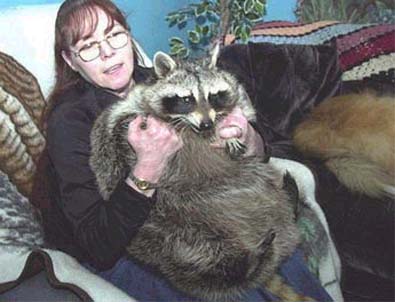
    a raccoon.

    Power Animals


    On Monday evening a few of us had rousing a discussion about power animals, while lounging in our enclosed porch. Not everyone is satisfied yet, but here's what we've come up with so far. Suggestions welcome.

    AE - raccoon (collects shiny things)
    KG - turtle (it's obvious)
    ST - panda (chill, contemplative, vegetarian)
    RS - llama (this one is contended)
    LW - blue-footed booby
    MMy - deer (or sandpiper)
    MMi - black bear
    LJ - platypus
    CB - red squirrel (it's obvious, sorry you are not a stealthy predatory cat)
    NS - i forget, was it an owl?
    AS - undetermined

    I'd like to take this opportunity to remind everyone that even though you may have recognizeable physical manifestations of your power animal, your friends can't truly pick your power animal for you. You must discover your own power animal, which usually occurs in a dream or vision. Also note that your power animal can change over your lifetime in response to your spiritual needs.

    power animal descriptions

    lessons on meeting your power animal

    70 Broad

    Mary emailed this description of our house out last night, but it's too good not to post here as well.

    This section is my favorite:
    The Loj House is a community of 12 residents. There are five double rooms and two singles in the house. It has a thriving border program that offers non-residents the opportunity to participate in the food co-op and join the house for dinners.

    The living room, dining room and kitchen create a warm and inviting atmosphere. ... There is a piano in the living room and a TV/VCR in the enclosed porch.
    [Edit] Maybe we lost the encolsed porch because it was unsatisfied with the food co-op and crossed the border?

    Also, remember how we almost made a short video about the house? The videos that were actually submitted are here. I haven't watched any of them yet, but I doubt they'll be as good as Move This Rock.

    Tuesday, February 12, 2008

    Two Events Response

    Hi all! Haven't posted anything yet, so here goes. This is an excerpt from something I wrote for the CORE class Rachel and I are in. We had to go to two campus events and discuss how it relates to the theme of the course: The Relational Selve (ie. how we percieve ourselves, our relationships, and what role our perception of morality and ethic of care plays into them) Very wishy washy. Anyway, I responded to the Focus the Nation speeches at the final dinner. (I tried, but failed, to incorporate "yeastie beasties." Don't take it too seriously, I had to tweak it to address the questions of the course, but take a look.

    The two events I went to were similar in theme and very relevant to our course. Today, the human relationship with the, "environment," or non-human world, is a hot topic in light of a wealth of social, political, and economic problems that often manifest themselves in environmental toxicity, degradation, and disaster. I think about my relationship to the world outside human relationships (because I think that’s really what we mean when we talk about the “natural world”) all the time. I change my ideas about how I should behave almost on a daily basis because this relationship is extraordinarily complex, and challenges traditional notions of morality, because humans tend to conceive of non-human relationships as secondary to human ones.
    One event I attended was the Focus the Nation Day Dinner and closing discussion. The audience that remained after eating consisted mostly of a smattering of students already involved in the issue of climate change awareness on campus. There were three speeches that night. The first was Rob Sobleman, President of the Student Government Association. The second was a member of Hamilton Board of Trustees, and the third was the president of Colgate Democrats. Rob Sobleman, although admittedly not as "up" on the issue at hand than some audience members, was an obvious choice as a speaker because he represents the primary vehicle for dialog between administration and student body. The Hamilton Trustee member was the only “politician” to come and enter into the conversation, which had been conceived as one among “administrators” with the political empowerment to enact change and students. The last speaker discussed the role of young people in the coming presidential election. She argued that the election process represented a perfect avenue for us to express our desire for action on the part of politicians to address global warming.
    Something struck me about the nature of the three speeches. Interestingly enough, in spite of traditional notions of liberal youth versus conservative adulthood, the students were those advocating the use of traditional avenues within an existing structure as a way to enact change. Though they were both excellent speakers, their talks were largely unemotional and matter of fact despite the gravity of the problem. The trustee member, however, though admittedly not as gifted a speaker as the two student leaders, spoke evocatively if not eloquently. He implored us as students to demand change in university policy, action, and habit. He stressed that we should be fighting (as opposed to working—my insinuation) to bring about change. My thoughts on the difference in tone and suggested avenues for change are related to our course material. I think the crux lies in a difference in two generations’ perceptions of self and the way in which they should relate to the society or the institutions within a society in which we live.
    The trustee member is of another generation: a sixty-eighter whose concept of change and the relationship of youth and authority is different than that of the younger generation. When he was a student, students perceived being young as a powerful position from which real and meaningful change could and should be enacted. The rationale was that they as students lacked the cemented bonds to the socio-economic structure upon which most adults are completely dependent upon and/or wedded to. (In this definition I include family, full-time job, home and other major possessions as well as the government-ordained responsibilities that go along with such ownership etc.) In fact, this ethos is related to our course because there existed an element of moral responsibility towards, or at least moral aversion to, the actions and ideology of the system to which they were not yet wedded or committed. The way we as students today, or so it seems to me, perceive ourselves in this still very similar socio-economic construct in the U.S. is very different.
    As for Rob Sobleman, although his speech was unemotional and simply outlined to steps we as students and he as a stuedent representative might take through the University’s avenues of discourse and change, Sobleman’s speech as one of “our” own, seemed to “hit home” much more than the Hamilton Trustee member’s. He outlined the ways in which we could definitively act in order to enact change in a practical way for a practical reason: climate change and the moral responsibility many of us associate with its mitigation. The same holds true for the President of Colgate Democrats.
    I think this difference is what lies at the heart of the audience's under-reaction that night at the Focus the Nation dinner to the words of a sixty-eighter who thought he understood his audience. Students of this generation are threatened in a different way than sixty-eighters. Whereas that older generation sought to stay out of war, prevent entrapment in a society the conventions and strictures of which they did not agree, or enact what they saw a positive social change, our generation, though these problems are as relevant today as they were then, seeks integration. We, as privileged college students and as a result of the lack of a draft, don’t need to worry about being forced into the military to put our lives on the line for a cause with which we may or may not agree; though it seems those who do agree would be less likely to do so if their lives were threatened. We are in the perfect position to enact social change to address the problems the solving of which we see as a moral imperative. We too have our share of our own uncertainties, but these are largely based on our ability to find an acceptable place within the system (which we seem to take for granted as static or at least not worth the risk to change) in which we can insert ourselves. Once we are ensconced, we seem to believe, wedded, we feel our uncertainties will disappear and we will be better equipped to solve the problems at hand. The older generation seemed to feel a level of immorality in that path. What has changed, I believe, is inextricably linked to a difference in our conception of morality and responsibility. We are driven by self-preservation, for some reason, before our sense of morality.

    Sunday, February 10, 2008

    Art + Sustainability =

    Here are a few websites addressing questions of environmental sustainability in a new media art type of way, brought to my attention at this weekend's symposium Environmental Art and New Media Technologies: Imagining Sustainable Futures:

    Superfund 365 - Spotlights one of the USA's most industrially polluted sites, one a day, for a year
    Ooz - Zoo backwards. Exploring human/animal interactions
    Arctic Listening Post - Real and potential arctic climate change - watch Rising North.
    FutureFarmers - Victory Gardens, Lunchbox Laboratories. Get inspired.

    Friday, February 8, 2008

    Thursday, February 7, 2008

    Why I Support Senator Obama for Election '08

    Before I get into my opinion, I should say that I think it's crucial that everyone independently assesses the facts for themselves before coming to a decision. I'm trying my best to appeal to logic, but obviously that logic is, on the basis of evolutionary reality, interwoven with my own emotional context. So I highly recommend you check out the biased and unbiased sources for yourself:

    http://www.hillaryclinton.com
    http://www.barackobama.com
    http://www.factcheck.org


    Opinon. While I'm not extremely informed on the nuances of either campaign platform, I feel comfortable saying that Obama and Clinton's priorities, as presented in their campaign platforms, are nearly the same. Both have fairly aggressive (and actually, quite similar) environmental policies specifically geared to curbing carbon emissions and energy dependency. Both advocate ending the Iraq war and expanding diplomacy with other nations (ie. Iran). Both advocate similar "opt-in" universal health care policies. Both recognize the need to boost our faltering educational system. And I'm not crazy in thinking the two candidates are reading from a similar page ideologically. According to factcheck.org, "the two candidates vote with Democrats more than 90 percent of the time and [have] voted with each other 94 percent of the time."

    Thus I don't base my support of Obama on specific issues so much as the overarching needs of this country and what I perceive each candidate can provide. Some would argue that this country needs someone to bring it back to the middle after Bush's reign, someone experienced who can roll into office ready to patch up what he trucked up, but I disagree that experience is a boon for this nation. The last first-term senator from Illinois didn't do so badly, now did he? I'm not saying that Obama is necessarily going to usher in the sort of new age for our nation that Lincoln did, but I'm saying it's possible, as history shows, that inexperienced politicians can do great things and experienced ones can blow it bigtime. (See picture.)

    I am of the opinion that experience has tempered Clinton's passion and desire for real change. We need change on two levels. First, we need progressive national policy change to enable our country to undo the damage it's done internationally and enable Americans to live healthier, more peaceful, more satisfied (and more responsible) lives. I think that both Clinton or Obama are capable of bringing about this sort of change and indeed both have a similar agenda for doing so. Second, and perhaps most importantly, we need to reclaim this nation for the people and by the people. I'm talking about the sort of change in office that invigorates people on an individual level. What sort of change is it to have our country run by the same two families for 24 (possibly 28 years?) It reeks of everything our political system isn't supposed to be about. We're not living in a democracy, at least not one that most people bother utilizing or paying attention to through local levels of government, where true democracy actually works. On the national level we're a meritocracy, where the only real merits are wealth and familial political fame.

    Contrasted with Clinton, Obama has the potential to bring the change I speak of. We need a president with the vitality and passion to bring people together and more or less heal some of the deep divisions in this nation. Over 600,000 Americans (myself included) have made personal donations to his campaign (bloomberg.com) . Indeed, he is building one of the strongest grassroots networks of presidential supporters our nation has seen. According to Bloomberg.com he's raised $7.1 million in just two days in response to Hillary's announcement that she has loaned her campaign $5 million. As another stark example, in January Clinton raised $13 million. According to Bloomberg.com, "Obama, by contrast, collected $32 million, the most ever raised by a Democrat in January of an election year, $28 million of which was raised in online donations." This offers a strong preliminary indication that he has an incredible power to involve the average person.

    I should note that my support of Obama doesn't diminish the respect I have for Clinton's candidacy. I do believe that she's an incredibly saavy, intelligent, and passionate (and odds are, like most of us, feeling) person, and that the expectations on her as a woman have been many and uniquely hard. But nevertheless, aside from her work with the health care system, I feel she does not bring a unique or fresh perspective to Washington. She's a woman, but she's rich, she's white, and she's not particularly concerned with overturning the status quo of meritocracy. I suppose, on a personal note, I do tend to underestimate the oppression of women, and the enormity of Clinton's campaign success. Yet that is not a substantial reason in itself to vote for her, just as it is not a substantial reason to vote for a candidate because he is biracial and the child of a Kenyan immigrant (as much as I feel his election would substantially bump our credibility in the world.) If I vote for Clinton, it will be for superficial reasons. I want my vote to mean more than that. Whether that means voting for Clinton or Obama, I hope everyone else does, too. That's why I support Barack Obama.